
Every subscription on your stack is not the same kind of cost. Some of them are software costs. Some of them are risk mitigation costs. If you are building in a regulated space and you are treating those two things the same way, you are either overpaying, under-protected, or both.
At Sinope, we have thought about this from day one. Not because we are unusually disciplined, but because as a solo founder, the audit scope is the thing you cannot afford to get wrong. If you let it sprawl, you do not just pay more in subscription fees. You pay in audit hours, in evidence collection, in the surface area a certifying body has to cover. Scope management is not an afterthought. It is a founding principle.
Some Subscriptions Are Infrastructure. Some Are Insurance.
When a founder looks at their monthly SaaS spend, the instinct is to ask: am I getting enough features for this price? That is the right question for most tools. It is the wrong question for a compliance-critical vendor.

Take Supabase Teams. The jump from lower tiers to Teams is significant, jumping to around $500 a month. If you are evaluating that on features alone, it is a hard sell. You are probably not using most of what the tier unlocks technically. But that is not why compliance-focused startups are on it.
The reason is ISO 27001. Supabase Teams includes access to their ISO 27001 certification documentation, and that matters because it directly reduces your audit scope. When your infrastructure provider carries the certification you are being audited against, you do not have to defend that surface area yourself. The auditor looks at the vendor's coverage and moves on. You pay $500 a month and you buy back hours of audit preparation, narrowed scope, and reduced risk exposure. That is not a software cost. That is an infrastructure decision wearing a subscription label.
The question to ask for any vendor in your stack is not just "what does this do?" It is "what does this vendor's compliance posture do to my audit scope?" If the answer is "nothing," that is fine, but you should know that is what you are getting. If the answer is "it shrinks the surface area I have to defend," that subscription belongs in a different budget category entirely.
Designing Your Stack Around Audit Scope
The conventional way to build a startup stack is to optimize for speed and cost per feature. Pick the cheapest tool that does the job. Upgrade when you hit limits. That logic works fine until you are staring down a certification audit and realizing that half your vendors have no relevant compliance posture at all.
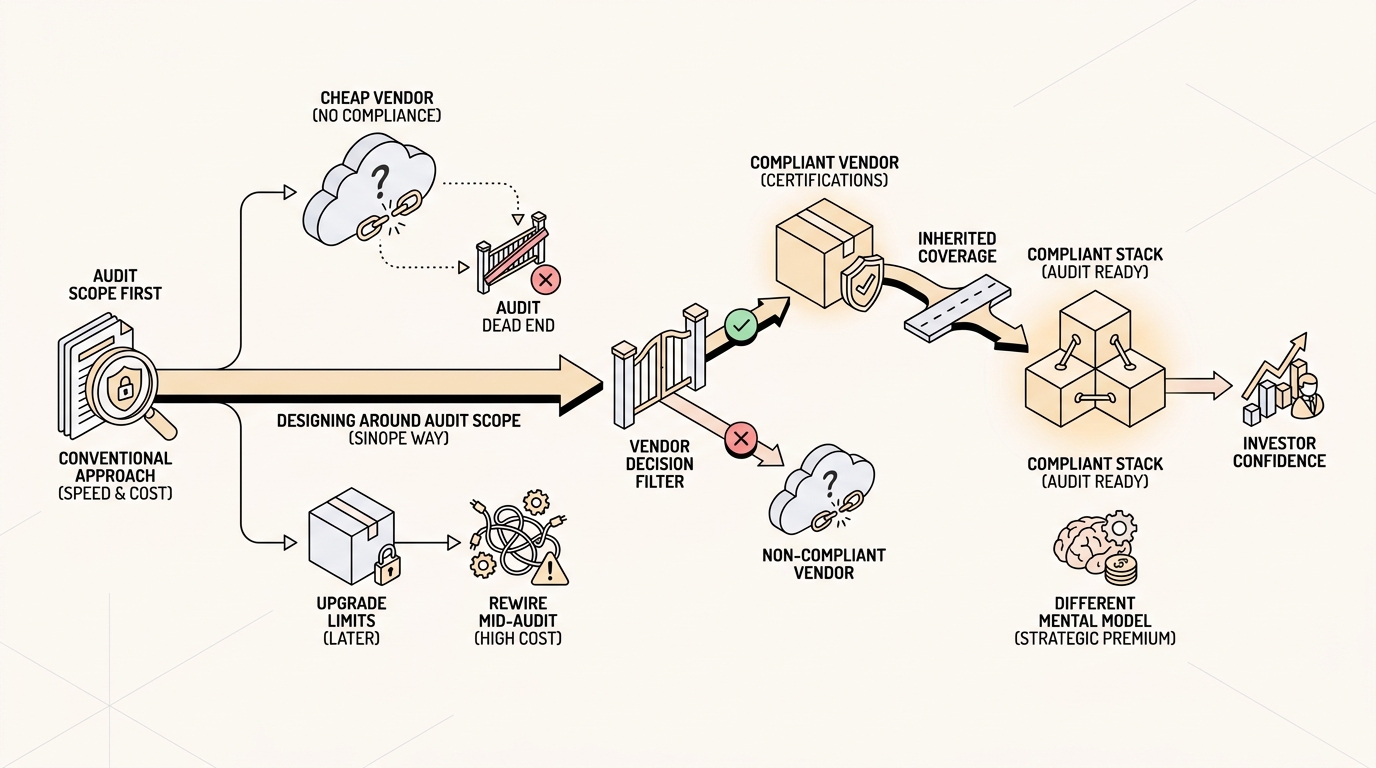
We do it differently. Every vendor decision we make at Sinope gets filtered through one question first: what does this do to our audit scope? That means we look at certifications before we look at pricing tiers. We ask whether a vendor's compliance documentation is available, whether it matches the standard we are being audited against, and whether being on their platform lets us inherit any of that coverage.
This is not a complicated framework. It is just a different order of operations. Most founders think about compliance after they have already committed to their stack. We think about it before. The cost of rewiring your vendor relationships mid-audit is much higher than the cost of choosing slightly more carefully upfront.
The practical implication is that your stack will sometimes cost more than a competitor's, at least on paper. A vendor with ISO 27001 documentation available at their business tier will charge more than one without it. You pay that premium deliberately, knowing what it is buying. That is a different mental model than "this is expensive," and it matters for how you justify the spend to yourself and, eventually, to investors.
The Equivalency Argument and When to Use It
Here is where it gets nuanced. Certification matching, meaning your vendor carries the exact certification you are being audited against, is the ideal outcome. But it is not always achievable without significantly narrowing your vendor options, sometimes to the point where cost or capability becomes a real constraint.

There is a fallback. In your ISMS documentation, you can argue that one certification is broadly equivalent to another. SOC 2, for example, covers a substantial overlap with ISO 27001 in terms of controls and risk management principles. If a vendor holds SOC 2 but not ISO 27001, you can document in your management system that you have assessed the equivalency and found it sufficient for your purposes. A competent auditor will engage with that argument if it is well-reasoned and properly documented.
We are aware of this option at Sinope. We are also deliberately deferring it. The reason is straightforward: arguing equivalency adds complexity to your audit documentation, and it opens a line of questioning that exact certification matching simply closes. It is not that the argument is weak. It is that not needing to make the argument at all is the cleaner outcome. So we are holding it in reserve. If we hit a point where the cost of exact-match certification vendors becomes genuinely unsustainable, the equivalency argument is the lever we pull. Not before.
The broader lesson here is that equivalency is a tool, not a loophole. Used well, it gives you flexibility in vendor selection and can meaningfully reduce costs. Used carelessly, it creates documentation debt and audit surface area that you will have to defend later. Know it is there. Be deliberate about when you reach for it.
When the Cost Is Actually Justified
None of this means you should pay whatever a compliance-credentialed vendor charges. The question is always whether the risk mitigation value matches the price. That requires actually knowing what you are getting in return.

For Supabase Teams, the calculus is clear for us. The ISO 27001 coverage reduces audit scope in a way that is directly relevant to what Sinope is building and what we will be audited on. The $500 a month is not comfortable for a solo founder at early stage, but it is a knowable, justifiable cost. We are not paying for features we do not use. We are paying for a compliance artifact that shrinks the surface area we have to defend. Those are very different things.
For other subscriptions, the answer might be different. A vendor that holds SOC 2 but not ISO 27001 might justify a lower tier precisely because the compliance value is partial. A vendor with no relevant certification at all should be evaluated entirely on features and cost, because that is all you are getting.
The discipline is in knowing which category each vendor falls into, and being honest with yourself about whether the compliance value you are paying for is real or just marketing language on a pricing page.
The Takeaway
Solo founders in regulated spaces are not just building a product. They are also building an audit-ready vendor stack, and every subscription decision is a scope decision. Some costs are software costs. Some are risk mitigation costs. The ones that reduce your audit surface area belong in a different mental bucket, evaluated against a different standard, and justified on different terms.

Design your stack around scope from the start. Know what each vendor's compliance posture actually does for your audit. Understand when certification matching is worth the price premium, and when the equivalency argument is a legitimate fallback. And be honest with yourself about when a subscription is earning its place and when it is just familiar.
The license to operate does not have to be as expensive as it looks. But you have to know what you are actually buying.