
There is a real tension at the heart of building an AI-native startup right now. Your idea can be replicated trivially, so you have to sprint from the blocks. And at the same time, the compliance requirements for regulated markets are not exactly a culture of speed and efficiency. Most founders treat those two realities as opposites. We think that is the wrong frame.
Automated governance is not a new concept. The whitepapers were being published in 2019. What is new is the infrastructure that most startups are already running, the CI/CD pipelines, the security tooling, the project management data, and the possibility of connecting that infrastructure directly to the evidence an auditor actually needs. The gap between "shipping fast" and "audit-ready" is smaller than it looks. The problem is that most founders are not connecting the dots between what their pipeline is already producing and what a compliance reviewer is asking for.
The Evidence Is Already There
Here is the practical version of automated governance for a small team: you do not build a compliance department. You collect the artifacts your development process is already generating and treat them as proof.
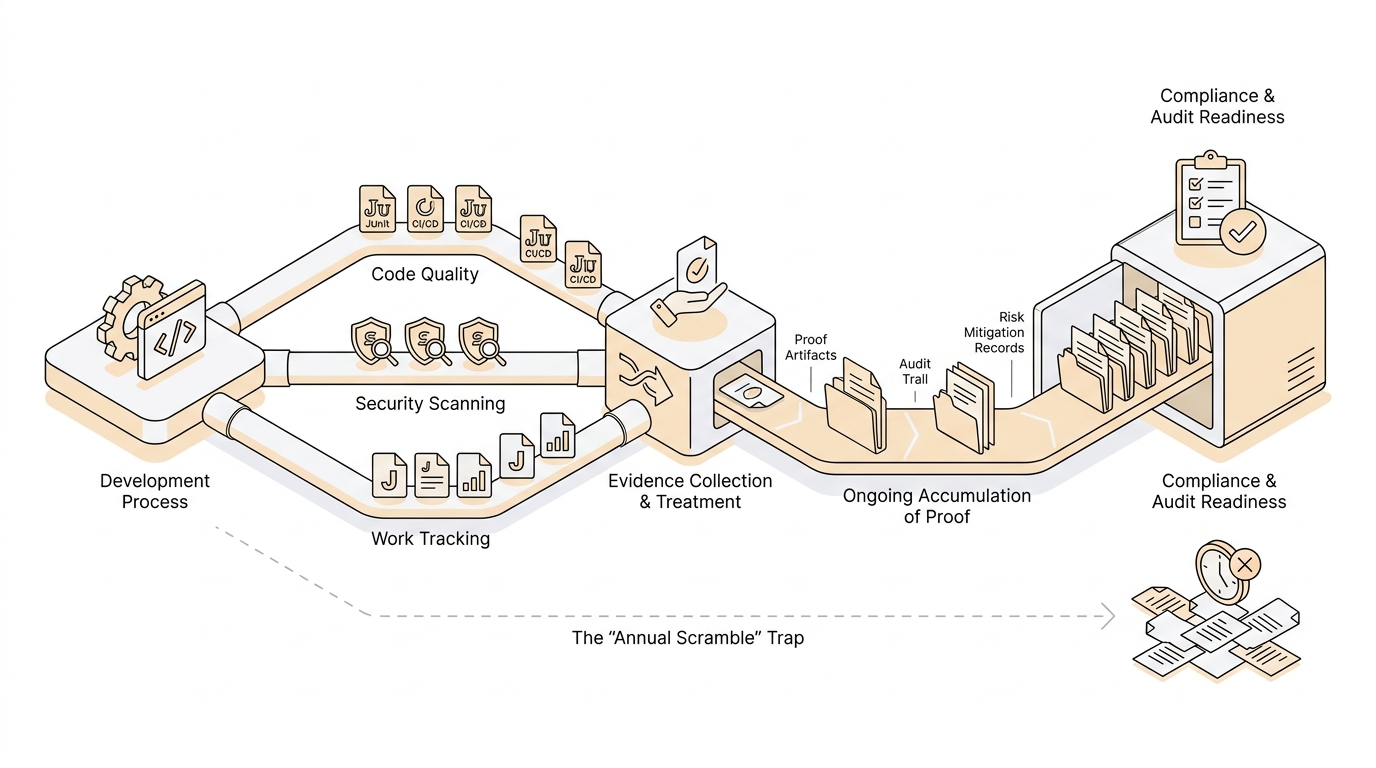
JUnit files from your CI/CD runs are evidence that you are actively mitigating the risk of poor-quality code. The build output from security tooling like SonarSource or Snyk is proof that you are doing security scanning. Jira data, exported to PDF (and yes, compliance people do have a specific fondness for PDFs), is a record of how work is being tracked, prioritized, and resolved. None of this requires a new system. It requires someone to recognize that these outputs have a second life as compliance documentation.
This is what continuous compliance actually looks like in practice. Not a once-a-year scramble before your audit window, but an ongoing accumulation of evidence that your quality management and security management systems are functioning. Will this alone get you through an entire certification? Probably not. But it materially reduces the distance between where you are today and where you need to be, and it keeps you from starting from zero every time an auditor asks a question.
The alternative, which is being compliant only at annual intervals, is a trap. You are always catching up, always reconstructing history, always trying to make your past behavior look more deliberate than it was.
The Timing Problem Nobody Talks About
Here is the honest version of when to start: after your MVP launches. That is the realistic answer. Before the MVP, everything is provisional, and nothing is as permanent as a temporary decision. If you decide not to build compliance thinking into your process because you will do it later, that is a decision, even if you do not recognize it as one. That temporary indecision has a way of becoming permanent.
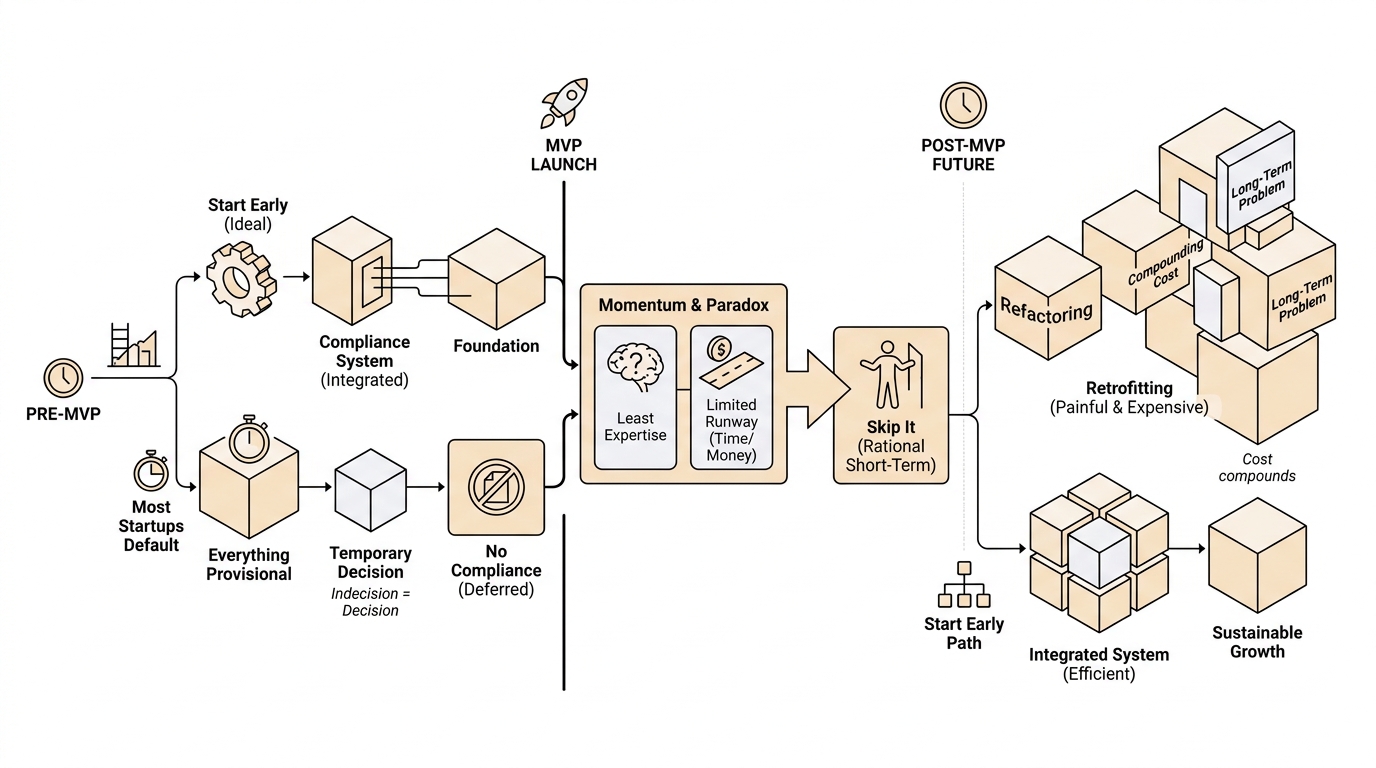
Retrofitting compliance systems into a business that was not designed with them in mind is painful and expensive. Extracting and refactoring those systems later is painful and expensive. The cost compounds. So the right answer, in principle, is to start on the right foot as early as possible.
But here is the paradox: the best time to start is also the moment when most founders have the least expertise to do it well. You launch your MVP, you have just enough momentum to feel dangerous, and now someone is telling you to think carefully about your quality management systems. You do not have a compliance background. You are probably not going to acquire one in the next three weeks. And your runway is not going to extend itself while you figure it out.
This is why most startups default to skipping it. Not because they are reckless, but because the cost of implementation feels immediate and the cost of not implementing feels distant. It is a rational short-term decision that creates an irrational long-term problem.
What We Actually Think You Should Do
Start minimal. After the MVP ships, identify the artifacts your pipeline is already generating and build a lightweight habit of collecting them. JUnit outputs, security scan results, ticket exports. Set up a folder structure. Name things consistently. Make it boring and repeatable, because boring and repeatable is exactly what an auditor wants to see.
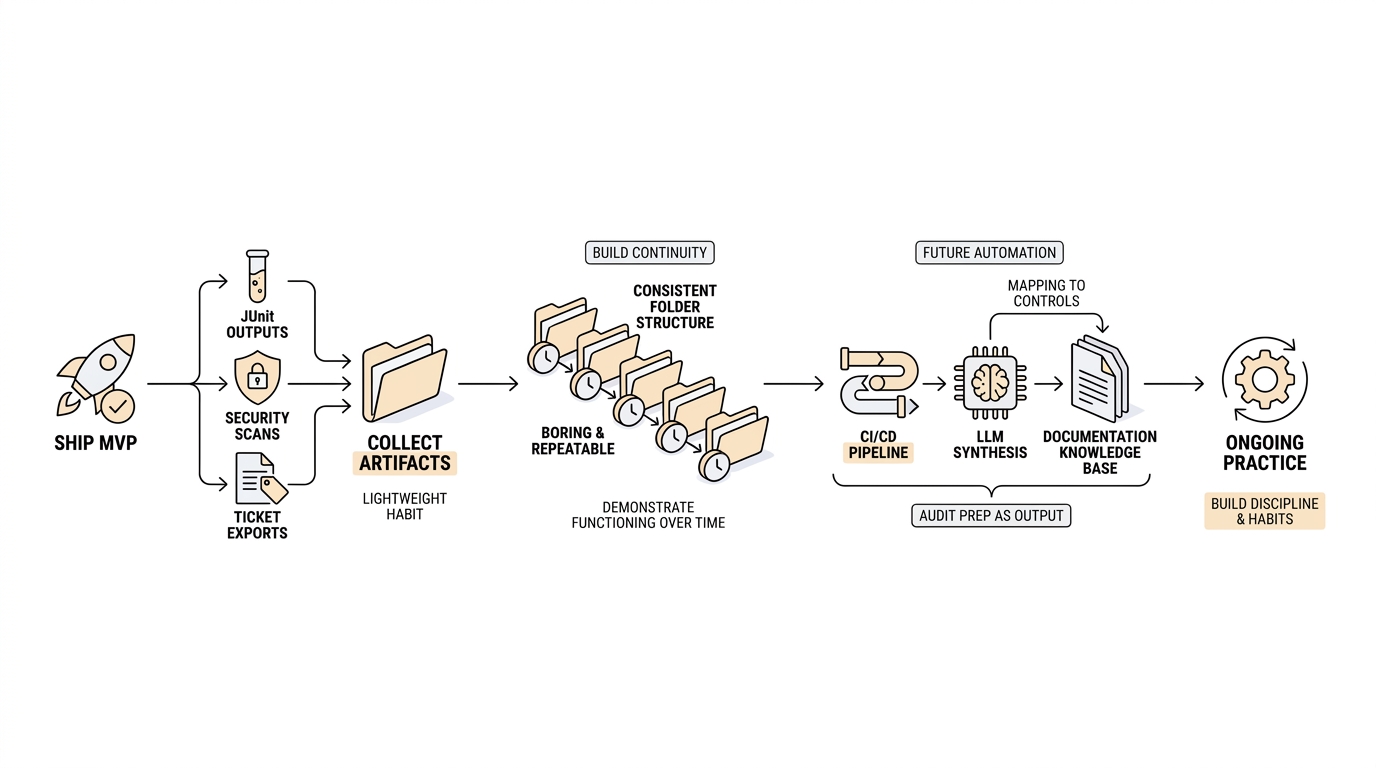
Do not try to automate the entire governance layer on day one. That is the kind of nice-to-have that burns runway and distracts from the work that actually keeps the company alive. The goal at this stage is not perfection. It is continuity. It is having a record that demonstrates your systems were functioning over time, not just in the week before someone came to look.
As your team grows and your expertise deepens, the automation can grow with it. There is a version of this where your CI/CD pipeline is feeding structured outputs into a knowledge base, where an LLM is synthesizing that into documentation that maps to specific compliance controls, where your audit preparation is largely a matter of pointing someone at a system that has been quietly building the case for you all along. That is a compelling future state. But it starts with collecting the JUnit files.
We will say this plainly: we can help with this, but we do not solve it. Nobody does. Compliance is not a problem with a clean solution, it is a practice, a discipline, a set of habits that you build into the way you work. What we can do is help you understand which habits matter, which outputs to collect, and how to connect what you are already doing to the framework an auditor is going to use to evaluate you.
The Actual Takeaway
The startups that will win in regulated markets are not the ones with the biggest compliance budgets. They are the ones that stop treating compliance as a separate exercise and start treating it as a byproduct of shipping well. The evidence is being generated either way. The only question is whether you are capturing it.
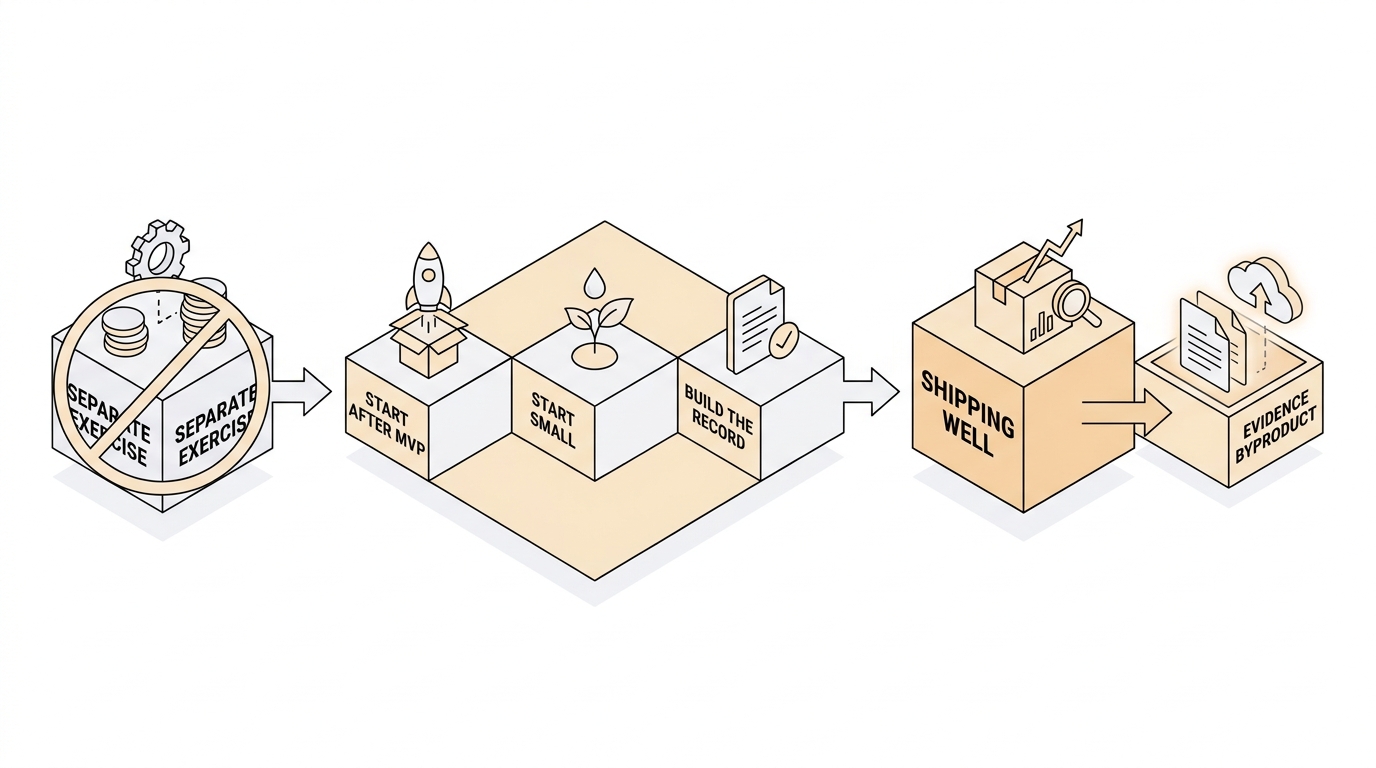
Start after the MVP. Start small. Start with what you already have. The cost of retrofitting later is real, and it scales with every month you wait. You built the thing. Now build the record that proves you built it right.