
There is a moment in every enterprise sales process where someone across the table asks: "Are you secure, and can you prove it?" What happens next is where startups win or lose deals, not on features, not on pricing, but on whether they can answer that question with something more than a shrug.
We have seen this play out firsthand. A startup selling GxP software into pharmaceutical vaccine monitoring, a genuinely hard regulated environment, stayed alive in a competitive deal because they could answer that question with a credible plan and a realistic timeline. Not a certificate on the wall. A plan. That was enough. The enterprise buyer waited. Because that is what enterprise buyers do: they move slowly, and they will accept a six-month certification runway if you give them a reason to believe you will actually cross the finish line.
The problem is that most founders do not understand that distinction. They think compliance is something you sort out after the sale. It is not. It is part of the sale.
Certification Is a Differentiator, Not a Formality
When two startups with comparable products show up to the same RFP, the one with ISO 27001 or a credible SOC 2 roadmap does not just look more trustworthy. It looks like the lower-risk bet. In regulated industries, procurement teams are not just buying software. They are buying accountability. They are buying something they can show to their own auditors, their own compliance teams, their own board.

The startup without certification is not just missing a checkbox. It is missing a signal that matters deeply to the buyer. And in a competitive RFP, that signal can be the entire margin of difference.
This is what we mean when we say certification is a sales weapon. It is not about compliance for its own sake. It is about what that certificate communicates in the room, before anyone has even opened a technical evaluation. It says: we have been scrutinised by an external auditor, we passed, and we can prove it.
If you are building an AI-native product and you are targeting enterprise in any regulated vertical, you need to think about certification the same way you think about your pricing model or your go-to-market. It is strategic, not administrative.
The Plan Matters More Than the Timeline
Here is the part most founders miss: enterprise buyers will accept a six-month timeline. They are used to it. Large organisations do not move fast, and they do not expect the vendors they evaluate to either. What they will not accept is vagueness.

"We are planning to do SOC 2" is not an answer. "We are currently in the gap analysis phase, we have engaged an auditor, and we are targeting certification by Q3" is an answer. That level of specificity is what keeps you in the deal.
The credibility gap is not between certified and uncertified. It is between founders who understand the process and founders who are winging it and hoping no one follows up. In a regulated industry, someone always follows up.
This is where experience becomes the actual differentiator, not your tech stack, not your team size. If you have never sat in an audit, you do not fully understand what an auditor is looking for. You do not know what evidence to collect, how to present it, or how to map your controls to the requirements in a way that actually holds up. You learn that by doing it, or by working with someone who has.
What Happens When You Get It Wrong
Failing an audit once is recoverable. It is uncomfortable, but it happens, and auditors understand it. Failing a second or third audit is a different story.

Every failed audit costs you money, and audit fees are not trivial. More importantly, every failed audit costs you time, and in a live sales process, time is the one thing you cannot buy back. When you have to go back to an enterprise prospect and explain that you failed your third audit, that is not just an awkward conversation. It is almost certainly the end of the deal. In highly regulated industries, that level of risk is disqualifying.
The founders who avoid this outcome are not necessarily more technical or better resourced. They are the ones who understood what the audit process actually requires before they started it. They knew how to tick the requirements, how to gather evidence systematically, and how to walk into the audit room with confidence rather than hoping for the best.
That knowledge used to be locked inside large compliance teams and expensive consultants. It was the kind of institutional knowledge that incumbents had simply because they had been around long enough to accumulate it. A solo founder building their first regulated product does not have a decade of audit experience to draw on. They have ambition, a product that works, and a deal on the table that requires a certificate they do not yet have.
That is precisely the gap we built Sinope to close.
The Compounding Value of Getting It Right Early
There is another dimension to this that does not get talked about enough. Certification is not just a one-time gate. It is a foundation.

Once you have gone through the process properly, once you understand what good looks like and have built your systems to reflect it, subsequent audits get easier. Your evidence is already there. Your controls are already documented. You are not scrambling to reconstruct six months of security decisions for an auditor. You are just showing them what you have been doing all along.
This matters enormously for startups that plan to grow. The compliance debt you accumulate by cutting corners early does not disappear. It compounds. Every new customer, every new geography, every new product feature lands on top of a foundation that either holds or does not. Founders who treat certification as a one-time checkbox often find out the hard way that the second audit is harder than the first, because the underlying systems were never built to sustain scrutiny.
The founders who treat it as a strategic capability, something to get right and then build on, are the ones who can walk into their second and third enterprise deals with a story that gets stronger over time, not more complicated to explain.
What This Means for You
If you are a solo founder building an AI-native product with enterprise ambitions in a regulated market, here is what to take away from this.
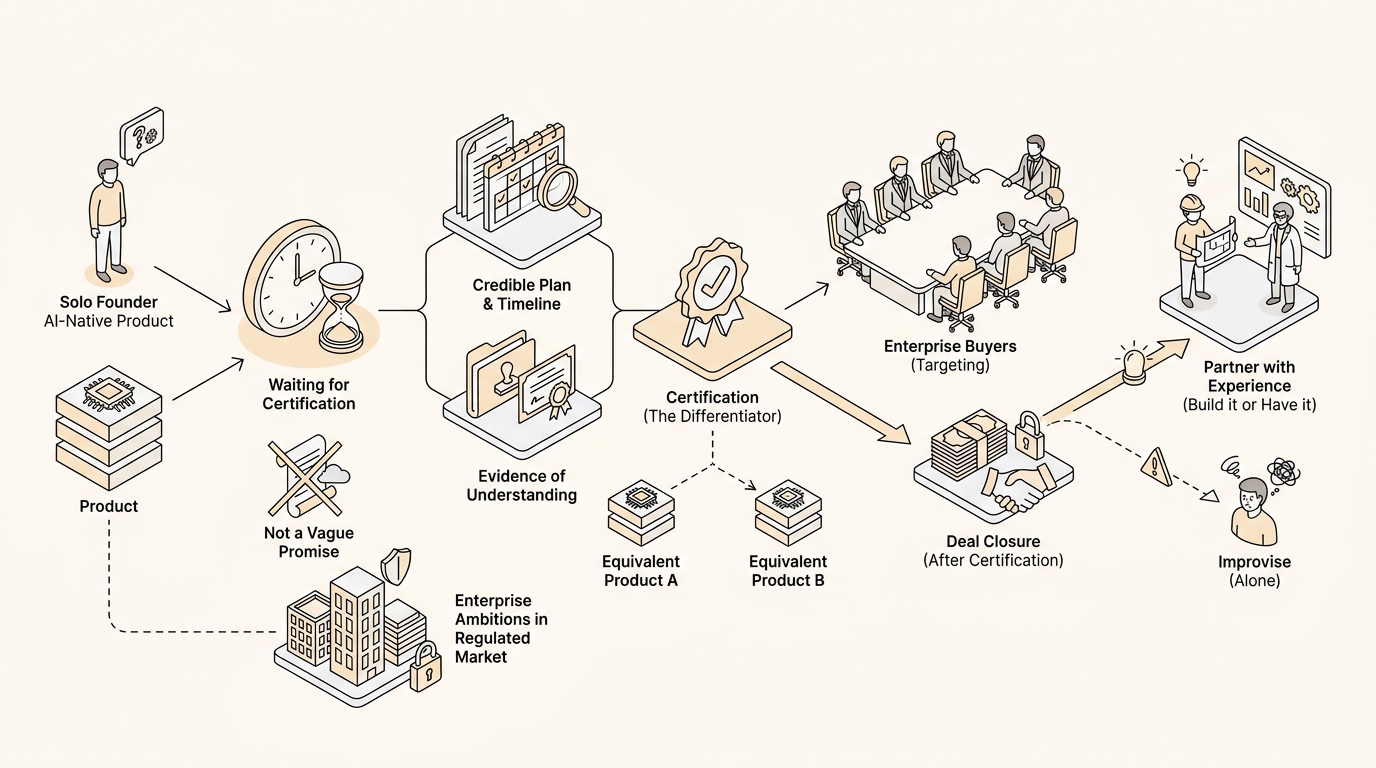
The enterprise buyers you are targeting will wait for certification. They are not in a hurry. But they will not wait for a vague promise. They need to see a credible plan, a realistic timeline, and evidence that you understand what you are signing up for.
Certification is not the thing you do after you close the deal. It is part of how you close the deal. It is the differentiator that keeps you on the shortlist when two products look roughly equivalent and the buyer is looking for a reason to choose.
And the experience required to do it well, to walk into an audit room and come out the other side on the first or second attempt, is not something you can improvise. It is something you either have or you build. If you are starting from scratch in a regulated space, the fastest path is not to figure it out alone. It is to work with someone who has already sat in that room and knows exactly what happens next.
That is the thing that separates founders who deliver on the promise from founders who are just making one.